
Industrial Cables
Reliable solutions for power and signal transmission in industrial applications
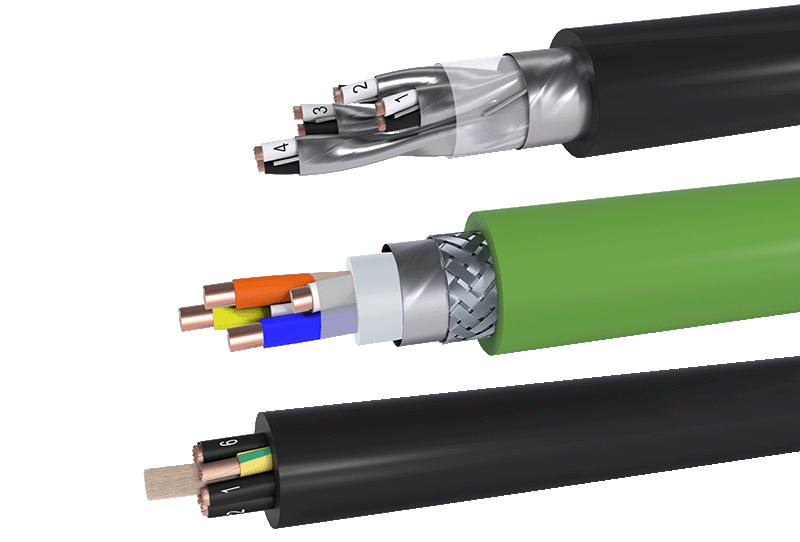
When the cable is a critical element
Recommended choice when the cable affects reliability, performance and service life.
- Continuous motion or dynamic routing
- Harsh environments (oils, moisture, temperature)
- Transmission of sensitive signals or power
- Need for durability and operational continuity
When over-specifying is not needed
Standard solutions are sufficient in simple and controlled contexts.
- Controlled environments and fixed routing
- Low mechanical stress
- Requirements already met
- Cost or space constraints
Typical mistake #1:
Underestimating motion
Cables not suited for flexing or cable carriers degrade quickly.
Typical mistake #2:
Inadequate shielding
It can cause interference and signal issues.
Typical mistake #3:
Materials not consistent with the environment
Oils, temperature and chemical agents reduce service life.
Required
selection parameters
To propose the right choice, we need just a few key data.
Application
Fixed, mobile, cable carrier
Environment
Oils, temperature, moisture
Signal / power
Type and sensitivity
Shielding
Required or not
Cross-section and current
Loads and sizing
Standards
Sector-specific requirements
Cable
types
Standard
1
Fixed applications and controlled environments
Flexible
2
For installations with motion
Harsh environments
3
Resistant to oils, temperature and demanding conditions
Typical Industries
Industrial Machinery
Harsh environments, vibrations, and continuous duty cycles.
Automation & Robotics
High dynamics, precision, and high-speed duty cycles.
Off-Highway & Earthmoving
Dust, mud, vibrations, and extreme operating conditions.
Energy and Storage Systems
Carichi variabili, continuità energetica, sistemi distribuiti.
Packaging and Food Processing
Frequent washdowns, high-speed production, and hygienic requirements.
Related
solutions

High-Reliability Connections
Mechanical stability, contact integrity, and resistance in harsh environments.
Wiring optimisation
Organizzazione, protezione e gestione efficiente dei cablaggi industriali.
Electrical power management
Stabilità, conversione e distribuzione efficiente dell’energia nei sistemi elettronici.
FAQ
Typical questions
The cable must be compatible with environment, motion and the type of signal or power carried.
An incorrect choice can cause faults, interference and reduced service life.
No: it is only required in the presence of electromagnetic interference or sensitive signals.
In other cases it increases cost and complexity without real benefits.
No: they are essential only when the cable is subject to flexing or continuous cycles.
In static applications a standard cable is sufficient.

We help you
choose the
right cable
Tell us application, environment and operating conditions: we’ll propose consistent and scalable solutions.