
Industrial Displays and HMIs for Professional Applications
23 June 2026 carols
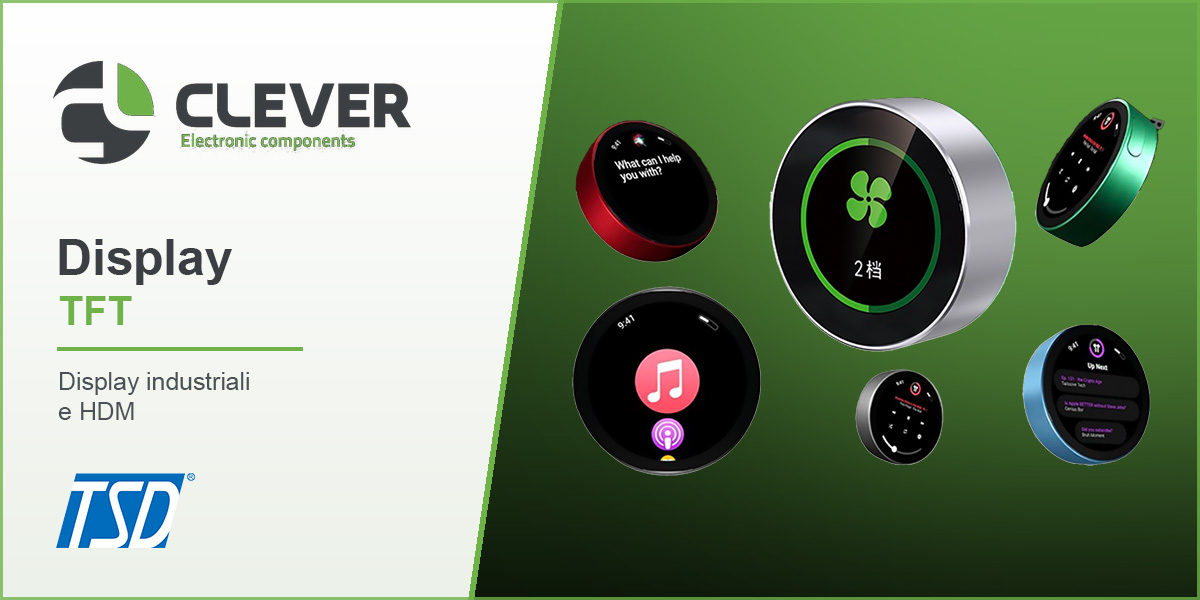
In modern industrial applications, the human-machine interface represents the point of contact between operator and system. The quality of the information displayed and the ease of interaction directly affect productivity, safety and operational continuity.
From automated machinery to energy systems, from industrial vehicles to medical devices, displays and HMI interfaces play an increasingly important role in process management and monitoring.
The selection of the right solution does not depend exclusively on screen size, but requires a thorough assessment of operating conditions and application requirements.
The role of HMIs in modern systems
Human Machine Interfaces enable operators to display information, monitor process parameters and interact with the machine in a simple and intuitive way.
Through an HMI it is possible to:
- monitor system status;
- display alarms and faults;
- modify operating parameters;
- consult diagnostic data;
- improve maintenance efficiency.
An effective interface design helps to reduce operator errors and improve the user experience.
Readability and visualisation quality
One of the most important aspects in selecting an industrial display concerns the readability of the information.
The operator must be able to quickly consult data and information under any operating condition.
For this reason it is necessary to evaluate:
- display brightness;
- contrast ratio;
- viewing angle;
- resolution;
- quality of the LCD or TFT technology.
Particular attention must be given to outdoor applications or those installed in particularly bright environments, where readability can become a critical factor.
Environmental conditions and ruggedness
Unlike displays intended for consumer electronics, industrial applications require significantly higher reliability levels.
HMIs can in fact be exposed to:
- vibration;
- mechanical shock;
- dust;
- moisture;
- extreme temperatures;
- continuous duty operation.
For this reason it is essential to select components specifically engineered for industrial and professional environments.
Mechanical ruggedness and long-term performance stability represent key evaluation criteria.
Touchscreen and interaction technologies
Interaction with the system is today an essential function of modern HMIs.
Touchscreen technologies make it possible to simplify machine operation and reduce the number of physical buttons and controls on the operator panel.
Among the aspects to be evaluated:
- touch sensitivity;
- operation with gloves;
- interaction accuracy;
- wear resistance;
- long-term reliability.
The selection of the most suitable technology depends on the operating environment and the intended usage modes.
Applications across industrial sectors
Industrial displays are used in a wide variety of applications.
Among the most common:
- industrial automation;
- robotics;
- packaging;
- energy systems;
- industrial vehicles;
- agricultural machinery;
- medical devices;
- railway systems.
Each sector has specific requirements in terms of ruggedness, readability, integration and reliability.
The importance of operational continuity
A display is often the main point of access to the machine’s information.
A malfunction of the interface can compromise the operator’s ability to monitor the system and intervene quickly in case of faults.
For this reason, the selection of components engineered to ensure operational continuity and long-term availability is particularly important in professional applications.
Product life-cycle management and supply availability become strategic factors especially in long-term industrial projects.
Solutions for reliable human-machine interfaces
The selection of an industrial display requires a comprehensive assessment of the application, considering environmental conditions, readability requirements, interaction modes and expected operating life.
To achieve reliable long-term performance it is essential to use components specifically engineered for professional applications and industrial environments.
Among the solutions available on the market, specialised manufacturers such as TSD Display develop industrial TFT displays engineered for applications characterised by high requirements of ruggedness, brightness and reliability.
The available solutions support applications in industrial, energy, medical, automotive and off-highway sectors, delivering high performance even under particularly demanding operating conditions.
Conclusions
Displays and HMI interfaces are key elements for the correct operation of modern industrial applications.
A careful selection makes it possible to improve the operator experience, increase safety, simplify maintenance and ensure long-term operational continuity.
Clever supports designers, OEMs, machine builders and system integrators in selecting the most suitable HMI solutions for specific application requirements, providing specialised technical expertise and access to the technologies of leading international manufacturers.